The Unheard Revolution: How Open-Ear Audio Technology is Reshaping Our Connection to Reality
Update on Oct. 14, 2025, 4:53 p.m.
The cyclist’s dilemma is a modern urban fable. Weave through traffic, the city a blur of motion and sound, and you face a stark choice: the immersive escape of a podcast, or the critical, life-saving auditory cues of the environment around you. For too long, the two have been mutually exclusive. This daily conflict, echoed in the routines of joggers, pedestrians, and even office workers, has highlighted a fundamental flaw in personal audio design. Data from the World Health Organization warns that over a billion young people are at risk of permanent, avoidable hearing loss due to unsafe listening practices, often involving high-volume, isolating earbuds. Concurrently, statistics from safety bodies like the U.S. National Highway Traffic Safety Administration (NHTSA) consistently point to pedestrian and cyclist distraction, partly due to being audibly cocooned from their surroundings, as a factor in traffic incidents.
This dilemma, faced by millions daily, is the fertile ground from which a new category of audio technology has sprung: Open-Ear Audio. It promises a world where you don’t have to choose between your soundtrack and your safety. It’s not just a new type of headphone; it’s a paradigm shift in our relationship with technology, moving from digital immersion to digital integration. The core value proposition is simple yet profound: to layer your digital audio onto the real world, not replace it.

The Two Paths to an Open Ear: Vibration vs. Air
To achieve this audio alchemy, engineers have pursued two primary technological paths, each rooted in a different principle of physics.
Path 1: Through Vibration (Bone Conduction)
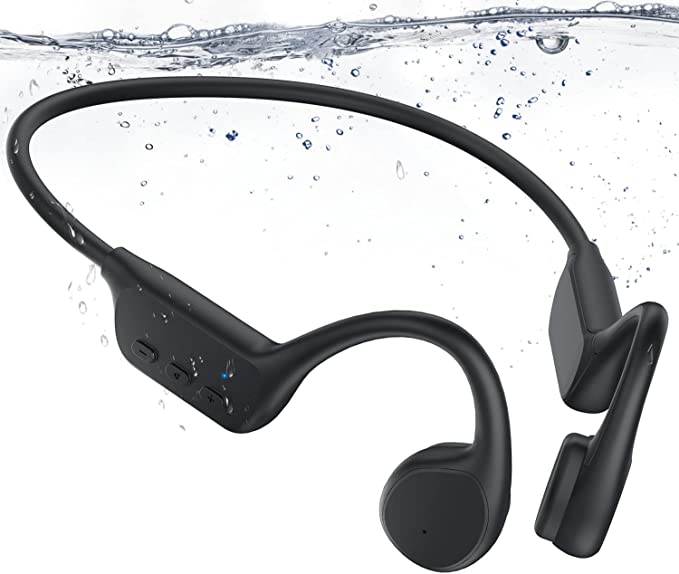
The more established and widely known method is bone conduction. Instead of using speakers to generate sound waves in the air, bone conduction transducers sit on your cheekbones and transmit micro-vibrations through your skull directly to the inner ear (the cochlea), bypassing the eardrum entirely. This feels magical at first; you can “hear” music with your ears completely uncovered.
- Advantages: The primary benefit is the near-total elimination of sound leakage. Since there’s no traditional speaker, people around you hear almost nothing. It’s also beneficial for individuals with certain types of conductive hearing loss.
- Disadvantages: This unique delivery mechanism comes with trade-offs. The audio quality, particularly in the lower bass frequencies, often feels thinner compared to traditional headphones. To produce perceptible bass, the vibrations need to be stronger, which can create a tickling or buzzing sensation on the skin that some users find uncomfortable during long listening sessions.
Path 2: Through Air (Directional Audio)
A newer and increasingly popular approach is air conduction, but with a clever twist: directional sound. Instead of plugging your ears, these devices use miniature, precisely placed speakers to create a focused beam of sound aimed directly at your ear canal. Think of it less like a naked lightbulb flooding a room with light, and more like a highly focused spotlight.
How is this “sound spotlight” created? It relies on a principle called constructive and destructive interference, a concept borrowed from advanced fields like Phased Array radar technology. In simple terms, imagine not one speaker, but a small array of them. By minutely delaying the signal to each speaker, engineers can control how the sound waves from each source interact in the air. They can be programmed to add up (constructive interference) at a specific point—your ear—while canceling each other out (destructive interference) in other directions. This creates a private sound bubble around your head.
- Advantages: The potential for audio fidelity is significantly higher than bone conduction because it uses traditional speakers, allowing for a richer, more natural frequency response. The form factor is also more flexible, enabling integration into devices where placing a transducer on the cheekbone isn’t practical, such as eyewear.
- Disadvantages: The primary challenge is physics itself. Controlling airborne sound is inherently more difficult than controlling vibrations in a solid. This leads to the most common complaint: sound leakage. In a quiet environment, a person nearby might faintly hear your music or conversation.
Real-World Application & The Engineering Balancing Act
Theory and principles are one thing, but how do these concepts translate into a product you can actually wear? Let’s examine a modern example, like the GetD 08B smart glasses which utilize the directional audio approach, to understand the real-world trade-offs. These glasses embed speakers into the temples, firing sound towards the user’s ears.
The design embodies the promise of seamless integration. You get audio without blocking your ears. However, user feedback often reflects the core challenges of the technology. Reports of “music being lightly audible to people around you” directly correlate to the sound leakage issue inherent in air conduction. The inclusion of a “dual-mic system” with noise-canceling technology is also telling; in an open-ear design, the microphones will inevitably pick up ambient noise, so sophisticated algorithms are required to isolate the user’s voice for clear calls—a challenge not as pronounced in isolating earbuds. This is a classic engineering balancing act: maximizing audio quality for the user while minimizing disturbance to others, all within the power and space constraints of a glasses frame.

The Fallacy of a “One-Size-Fits-All” Solution: The Importance of Context
The rise of open-ear audio could tempt one into a black-and-white view: isolating headphones are “bad” and open-ear solutions are “good.” This is a dangerous oversimplification. The truth is that different audio technologies are different tools, each suited for a specific context.
- High-Noise Environments (e.g., Airplanes, Subways): Here, high-quality, isolating, noise-canceling headphones are not a liability but a protector of hearing. They allow you to listen at a lower, safer volume by removing the need to overpower the ambient roar. An open-ear device would be largely ineffective.
- Focused Work (e.g., Coding, Writing): The gentle isolation of over-ear headphones or the “do not disturb” signal of earbuds can be a powerful productivity tool.
- Situational Awareness (e.g., Cycling, Running, Parenting): This is the undisputed home turf of open-ear audio. The ability to monitor a sleeping baby, listen for an approaching car, or hear a colleague’s question is paramount.
The intelligent consumer doesn’t seek a single silver bullet, but rather curates a toolbox of audio solutions for the diverse soundscapes of their life.
The Horizon: Smarter, Sharper, and Truly Personal Audio
If today’s choice is about picking the right tool for the right job, tomorrow’s promise is a tool that adapts itself. The horizon of personal audio is buzzing with innovations that could make the current challenges of open-ear technology a distant memory.
Companies like Noveto Systems are pioneering more advanced forms of “sound beaming” using ultrasonic waves, which can create even more private and precise pockets of sound, virtually eliminating leakage. Imagine walking into a room and having sound follow you, audible only to you, with no hardware on your head at all. Furthermore, the integration of AI will be transformative. Future devices could use microphones to actively map the acoustic properties of a room and the location of other people, dynamically adjusting the sound beam in real-time to maintain privacy.
Conclusion: More Than Just Hearing Music
Open-ear audio technology, in all its forms, represents more than just a new way to listen to music. It’s a direct response to our growing need to manage the dual realities we inhabit—the physical and the digital. It’s a move away from tech that demands our full attention and towards tech that augments our presence in the world. While the technology is not yet perfect, with challenges like sound leakage and contextual appropriateness still being refined, its trajectory is clear. The unheard revolution is about creating a future where technology doesn’t pull us out of the world, but helps us live more safely, awarely, and seamlessly within it.