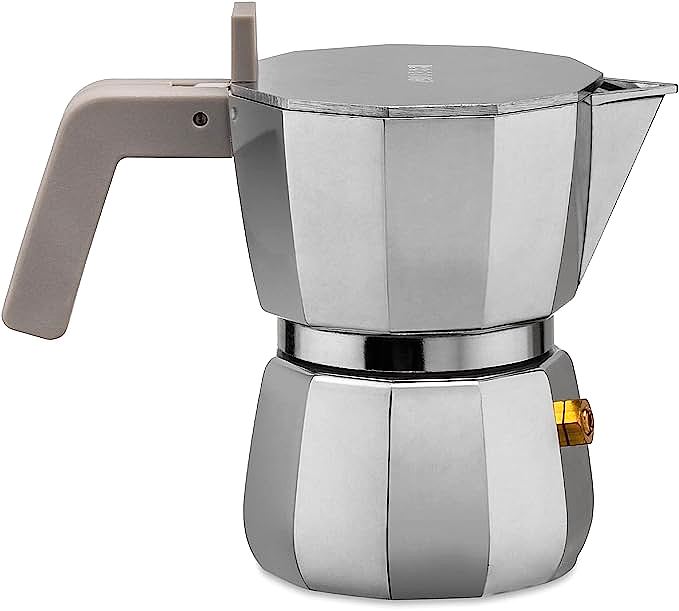
Thermodynamics of the Stovetop: How the Moka Pot Democratized Pressure
Update on Jan. 9, 2026, 7:35 a.m.
If the steam engine was the catalyst for the Industrial Revolution, the Moka pot was the catalyst for the Domestic Coffee Revolution. Before 1933, “espresso”—a coffee prepared rapidly under pressure—was exclusively a public experience, confined to the grand cafés of Milan, Turin, and Rome. It required massive, boiler-driven machines capable of generating 9 bars of pressure.
The invention of the Moka Express by Alfonso Bialetti changed the hydraulic landscape of the Italian home. It miniaturized the steam boiler, bringing the physics of pressure extraction onto the kitchen stove. However, this device is not magic; it is a thermodynamic engine that relies on precise variables to function correctly. And like any engine, it requires the correct fuel.
In the case of the Moka pot, that fuel is often the Lavazza Crema E Gusto Ground Coffee Blend. This pairing is not coincidental. The physical properties of this blend—its grind size, its solubility, and its lipid content—are calibrated to interact with the unique low-pressure environment of the stovetop brewer. To brew a perfect cup is to understand the fluid dynamics at play.
The Physics of Vapor Pressure: How It Works
Contrary to popular belief, the Moka pot does not boil water through the coffee. If it did, the coffee would be universally burnt and undrinkable. Instead, it utilizes the principle of vapor pressure displacement.
The device consists of three chambers: the bottom boiler (for water), the middle funnel (for coffee), and the top collector (for the brew). As the water in the sealed bottom chamber heats up, it begins to transition into steam. In a closed system, this phase transition increases the pressure within the chamber.
The 1.5 Bar Threshold
Crucially, the pressure in a Moka pot only reaches about 1.5 to 2 bars—significantly lower than the 9 bars of a commercial espresso machine. This pressure pushes the sub-boiling water (ideally around 90-95°C) up the funnel, through the coffee bed, and out into the upper chamber.
This lower pressure differential fundamentally changes the extraction mechanics. At 9 bars, water can force its way through a highly compacted, powder-fine puck of coffee. At 1.5 bars, the water needs a pathway. This is why the “Tamping” variable is removed from Moka brewing. Tamping the coffee creates too much resistance; the pressure isn’t high enough to overcome it, leading to a stalled brew or a safety valve release.
Granulometry and Darcy’s Law
This brings us to the science of the grind, or “granulometry.” The flow of liquid through a porous medium (the coffee bed) is described by Darcy’s Law. Simply put, the rate of flow is determined by the pressure difference and the permeability of the medium.
The Lavazza Crema E Gusto grind is engineered specifically for this equation.
- If the grind were coarser (French Press style): The permeability would be too high. The water would rush through the large gaps between particles too quickly, failing to extract the necessary solids and oils. The result would be sour, weak, and “underextracted.”
- If the grind were finer (Commercial Espresso style): The permeability would be too low. The 1.5 bars of steam pressure would struggle to push the water through. The water would hang in the coffee bed for too long, absorbing harsh tannins and resulting in a bitter, “overextracted” sludge.
Lavazza’s “Espresso Grind” is actually a hybrid. It is fine enough to provide the necessary hydraulic resistance to build up that 1.5 bars of pressure, ensuring a proper extraction time, but coarse enough to allow flow without the aid of a mechanical pump. It is the “Goldilocks” particle size for steam-driven extraction.
The Chemistry of Temperature: The “Burn” Myth
One of the most common complaints about Moka pot coffee—and dark roasts like Crema E Gusto in general—is bitterness. Often, this is blamed on the beans. Scientifically, it is almost always a failure of thermal management.
The metal of the Moka pot is an excellent conductor of heat. If left on the stove too long, the water boils, and the aluminum body itself becomes hot enough to scorch the coffee grounds before the water even hits them. Furthermore, at the very end of the brewing cycle, a phenomenon occurs called the “Strombolian phase.”
The Strombolian Phase
As the water level in the boiler drops, the siphon tube is no longer submerged in liquid but is exposed to the high-pressure steam. This steam rushes through the coffee, sputtering and gurgling. Steam is hotter than boiling water (100°C+) and carries immense energy.
This superheated steam “burns” the coffee, extracting harsh, dry distillates and destroying the delicate lipids that form the crema.
- The User Error: Leaving the pot on the stove until it stops gurgling.
- The Scientific Correction: Removing the pot from the heat source before the gurgling starts, or immediately upon hearing the first hiss.
Lavazza Crema E Gusto is a dark roast, meaning its cellular structure is already partially degraded and its sugars caramelized. It is more soluble than a light roast. This makes it highly efficient but also highly sensitive to thermal abuse. The “Spicy” and “Chocolaty” notes can turn to “Ash” and “Charcoal” if the Strombolian phase is allowed to occur.
Emulsification in Low Pressure: The Role of Robusta (Again)
We discussed in Article 1 how Robusta beans are the champions of crema due to their high CO2 and lipid interactions. In the context of the Moka pot, this becomes even more critical.
Commercial machines use 9 bars of pressure to violently emulsify oils into water, creating crema even with moderate-lipid beans. The Moka pot’s 1.5 bars is a much gentler process. It struggles to create a true emulsion.
This is why a blend like Lavazza Crema E Gusto, with its significant Robusta component, is the traditional choice for Moka brewing. The Robusta acts as a “crema aid.” Its high gas content and specific surfactants allow it to form a foam even at these lower pressures. A 100% Arabica coffee in a Moka pot often comes out flat and black. The Crema E Gusto, brewed correctly, will produce a rich, hazelnut-colored micro-foam that mimics the commercial espresso experience, despite the lack of a mechanical pump.
The Sociology of the Ritual
Understanding the physics enhances the sociology. The Moka pot ritual—filling the boiler, leveling the Lavazza grounds, screwing the chambers shut—is a daily act of engineering performed by millions. It is a moment where the consumer interacts directly with the variables of heat and pressure.
The vacuum-packed brick of Crema E Gusto is the constant in this variable environment. While the stove heat might change, or the water hardness might vary, the industrial consistency of the Lavazza blend provides a reliable baseline. It is a product designed not just for flavor, but for performance in a specific mechanical context.
Conclusion: Analog Mastery
The combination of the Moka pot and Lavazza Crema E Gusto is a testament to analog mastery. In an age of digital, one-touch pod machines (which have their own merits), the stovetop method requires an understanding of thermodynamics. It requires listening to the phase change of water. It requires managing thermal inertia.
When you drink a cup brewed this way, you are tasting the result of a physical equation: Vapor Pressure + Hydraulic Resistance + Soluble Yield = Gusto. The bitterness is not a flaw; it is a sign of high extraction. The body is not an accident; it is the result of Robusta lipids surviving the journey through the funnel. It is a cup of coffee brewed not just with heat, but with physics.